
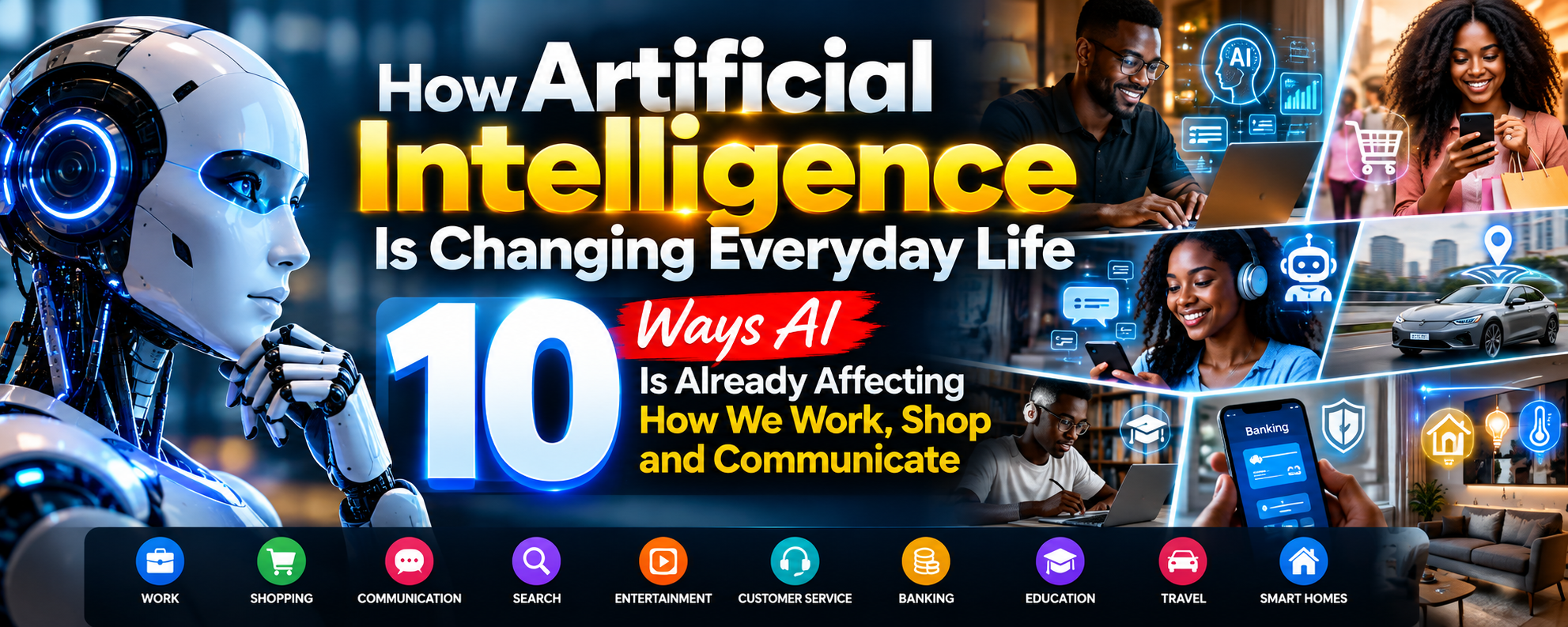
How Artificial Intelligence Is Changing Everyday Life: 10 Ways AI Is Already Affecting How We Work, Shop and Communicate
Artificial Intelligence in Everyday Life: 10 Ways AI Is Changing How We Live
Artificial intelligence was once something most people associated with science fiction, advanced laboratories and futuristic technology. Today, AI has quietly become part of everyday life.
From the recommendations that appear when we shop online to the navigation apps that help us avoid traffic, artificial intelligence increasingly influences how we work, communicate, learn, spend money and make everyday decisions.
Many people already interact with AI several times a day without necessarily realizing it. Smartphones, search engines, online stores, streaming platforms, financial institutions and workplaces increasingly use AI-powered systems to provide faster and more personalized services.
ALSO, READ PreacherMan AI Launches on Microsoft Store for Churches
So, how exactly is artificial intelligence changing everyday life? Here are ten areas where its impact is already becoming visible.
1. AI Is Changing How We Work
One of the most noticeable effects of artificial intelligence is happening in the workplace.
Businesses are increasingly using AI-powered tools to automate repetitive tasks, organize information, analyze data, prepare reports and assist employees with routine administrative work.
Generative AI has expanded these possibilities even further. Workers can now use AI to brainstorm ideas, summarize documents, draft correspondence, analyze information and assist with research.
This does not necessarily mean that every job will disappear. Instead, many jobs are likely to change as certain tasks become automated while employees spend more time on responsibilities requiring judgment, creativity, communication and specialized knowledge.
Learning how to work effectively with AI may therefore become an increasingly valuable professional skill.
2. Online Shopping Is Becoming More Personalized
Have you ever searched for a product and later discovered similar recommendations appearing across different websites?
Artificial intelligence plays an important role in modern e-commerce.
Online retailers can analyze information such as browsing activity, previous purchases and product interactions to recommend items that may interest individual customers.
AI can also help businesses manage inventory, forecast demand, improve customer service and identify purchasing patterns.
For consumers, this can make shopping faster and more convenient. However, it also raises important questions about privacy and how companies collect and use customer data.
3. Communication Is Becoming Faster
Artificial intelligence is increasingly influencing how people communicate.
Email platforms can identify spam, suggest responses and help users complete sentences. Translation technologies can convert conversations and written material between languages more quickly than before.
AI-powered writing assistants can also help people improve grammar, summarize long messages or adjust the tone of their writing.
Businesses are using AI chatbots and virtual assistants to answer common customer questions around the clock.
These systems do not eliminate the importance of human communication, but they can reduce the amount of time spent handling repetitive conversations.
4. Search Engines Are Becoming More Conversational
For many years, searching the internet primarily involved entering keywords and browsing through pages of results.
Artificial intelligence is changing that experience.
Modern search and AI systems can increasingly interpret questions expressed in natural language and provide synthesized responses to complex queries.
Instead of searching several variations of the same phrase, users can often ask detailed questions and continue the conversation with follow-up questions.
This makes finding information more convenient, although users should still verify important information because AI-generated responses can occasionally be incomplete or incorrect.
5. Entertainment Is Being Shaped by Algorithms
Artificial intelligence already influences much of the entertainment people consume.
Streaming services use recommendation systems to suggest movies, television programs, music and other content based on previous activity and broader viewing patterns.
Social media platforms similarly use algorithms to determine which posts and videos appear prominently in users’ feeds.
AI is also becoming part of content creation itself. Creators can use AI-assisted technologies for editing video, generating captions, improving audio, creating graphics and brainstorming ideas.
As these technologies improve, the relationship between human creativity and automated tools will continue to evolve.
6. Customer Service Is Becoming More Automated
Customer support is another area undergoing rapid change.
Companies increasingly use AI-powered chatbots to answer frequently asked questions, track orders, recommend products and direct customers to appropriate departments.
More advanced systems can analyze customer requests and determine what type of assistance may be required before a human representative becomes involved.
When implemented effectively, this can reduce waiting times and allow customer-service teams to concentrate on more complicated cases.
However, businesses still need human representatives for situations involving unusual circumstances, sensitive concerns or decisions requiring judgment.
7. Banking and Financial Services Are Becoming Smarter
Artificial intelligence has become an important technology within financial services.
Banks and payment providers can use automated systems to identify unusual transaction patterns that may indicate fraud. AI can also assist with risk analysis, customer support and financial forecasting.
Consumers increasingly encounter AI through budgeting applications and digital financial assistants that categorize spending and provide insights into financial habits.
These developments can make financial services more convenient, but important financial decisions should not be made solely on the basis of automated recommendations.
8. Education Is Becoming More Personalized
Traditional education often requires one teacher to serve many students who learn at different speeds.
AI-powered educational systems have the potential to provide more personalized learning experiences.
Students can use AI tools to receive explanations, generate practice questions, summarize difficult concepts and obtain feedback.
Teachers can also use technology to assist with lesson planning, administrative responsibilities and the preparation of educational materials.
Nevertheless, AI should complement rather than replace critical thinking. Students still need to evaluate information, conduct independent research and develop the ability to solve problems themselves.
9. Travel and Transportation Are Becoming More Efficient
Artificial intelligence is already involved in many journeys.
Navigation applications can analyze traffic conditions and recommend alternative routes. Airlines and travel platforms use sophisticated systems for scheduling, pricing and customer support.
Ride-hailing platforms also rely heavily on algorithms to connect passengers with drivers and estimate journey times.
The development of autonomous vehicles represents an even more ambitious application of AI, although widespread deployment continues to involve significant technological, regulatory and safety challenges.
Even without fully autonomous transportation, AI is already helping millions of people plan journeys more efficiently.
10. Smartphones and Smart Homes Are Becoming More Intelligent
Perhaps one of the clearest examples of AI becoming part of everyday life is the smartphone.
Modern phones use AI for features such as facial recognition, photography enhancement, voice assistance, predictive typing and spam detection.
Smart-home technologies are extending similar capabilities into homes.
Connected devices can automate lighting, adjust temperature settings, monitor security systems and respond to voice commands.
As these technologies become more sophisticated, homes and personal devices are likely to become increasingly responsive to individual preferences.
The Benefits and Challenges of an AI-Powered World
Artificial intelligence offers significant opportunities. It can automate repetitive work, improve accessibility, accelerate research, personalize services and help people process large quantities of information.
But those benefits also come with challenges.
Privacy, cybersecurity, misinformation, algorithmic bias, employment disruption and the responsible use of personal information are increasingly important concerns.
Another challenge is overdependence. AI systems can produce convincing information that is nevertheless inaccurate. Human judgment, verification and accountability therefore remain essential, particularly when decisions involve health, finance, employment, security or other consequential matters.
What Comes Next?
Artificial intelligence is unlikely to remain a separate category of technology that people consciously choose to use. Increasingly, it will simply become part of the infrastructure behind everyday products and services.
The important question may therefore shift from “Do I use artificial intelligence?” to “How is artificial intelligence being used in the products and services around me?”
Understanding that distinction will become increasingly important.
People who understand both the capabilities and limitations of AI will be better positioned to use these technologies productively while recognizing when human expertise, privacy safeguards and independent judgment are necessary.
Conclusion
Artificial intelligence is no longer only a prediction about the future. It is already influencing how people work, shop, communicate, learn, travel, manage money and entertain themselves.
Its presence will likely become less noticeable as AI becomes embedded in ordinary digital services. Just as people rarely think about the complex technologies behind internet searches or mobile payments, future generations may regard AI-powered assistance as an ordinary part of daily life.
The transformation is already underway. The challenge now is ensuring that artificial intelligence remains a tool that helps people make better decisions, solve problems and improve productivity—while preserving the human judgment and responsibility that technology cannot replace.