Christianity, Revival, and the Making of America
What Nigeria must learn about prayer, work and nation-building.
At a glance
- Nigeria is deeply religious, yet struggles with weak institutions and infrastructure.
- America had revival and built schools, industries and institutions.
- Nigeria’s issue is less a prayer problem than a translation problem.
- Real revival should produce people of character and competence.
Apostle Romeo Sai’s remarks on Nigeria’s calling to revival drew support and criticism. Critics argue that Nigeria’s religiosity has not produced matching economic, institutional or infrastructural progress. It is a fair frustration: churches are full and Pentecostal ministries are influential, yet power supply, corruption, unemployment and insecurity persist.
If revival is central to Nigeria’s spiritual identity, why has it not produced national transformation?
American history offers a useful lens. Not to romanticise it, and not to claim Christianity alone made America prosperous (geography, resources, immigration, industry, capital and even slavery all played roles), but it would be equally inaccurate to erase Christianity from the story.
Christianity Before the Birth of the United States
Puritans, Quakers, Presbyterians, Baptists, and others shaped colonial life, from morality and education to attitudes toward work. Yet not every settler came for religion, and colonial America carried deep contradictions: slavery, displacement of Native peoples, and intolerance. A society can be deeply religious and still carry serious moral failures.
The Great Awakening and the Culture of Revival
In the eighteenth century, Jonathan Edwards and George Whitefield led an evangelical revival that strengthened a shared religious culture and stressed personal conversion and moral responsibility.
ALSO, READ The Sacred Language of Strings: Why Violins Speak to the Spiritual Soul
America had revivals before it became an economic power, so revival is not automatically the enemy of development. The real question: what does revival produce after the meeting ends?
Was the American Constitution Built on Christianity?
Not directly. Christianity shaped the society that wrote it, but Article VI bans religious tests for federal office, and the First Amendment bars an established church while protecting free exercise. The result: a strongly religious society without a national church.
The Declaration of Independence and the Language of God
The Declaration speaks of rights from a “Creator”, reflecting a culture familiar with providence and Christian moral vocabulary. The founders varied, though: some traditional Christians, others shaped by Deism and the Enlightenment.
In God We Trust” and America’s Public Religious Identity
The phrase is not in the Constitution. It appeared on coins during the Civil War and became the national motto in 1956, showing that religious language stayed part of public identity long after the founding.
The Second Great Awakening: When Revival Became Organisation
Under revivalists like Charles Finney, spiritual energy turned into structure: Bible societies, missions, schools, charities, temperance and reform movements, and engagement with abolition, prisons and education. People organised, raised money, published and entered public debate. Spiritual energy became institutional energy. This is the strongest lesson for Nigerian Christianity.
Christianity and the Building of American Education
Harvard, Yale and Princeton all began in religious settings. Believers built schools, libraries and scholarship, understanding that prayer could not replace education. No nation advances without investing in human capital.
Christianity, Work and the Protestant Work Ethic
Max Weber tied Protestant ideas of vocation, discipline and thrift to capitalist culture. Scholars debate how far, and it would be simplistic to say Protestantism created American prosperity. Still, beliefs can shape attitudes to work, honesty and responsibility. Development itself needs farmers, manufacturers, engineers, entrepreneurs, scientists, banks, courts and governments. Faith shapes the character of those doing the work; it does not remove the need for the work.
America Was Not Built by Christianity Alone
Resources, immigration, industrialisation, transport, markets, technology and capital drove America’s rise, alongside grave injustices: coerced labour of enslaved Africans, violence against Native peoples and lasting racial discrimination.
The argument must never be “America was Christian, therefore America became rich.”
More defensible: Christianity was one important part of the cultural and institutional environment of American development.
Revival in an Industrialising Nation
D. L. Moody preached to vast crowds while railways spread, factories multiplied, and universities grew. The evangelist preached, the engineer built, and the teacher taught. A nation needs both conviction and competence.
Azusa Street and the Rise of Modern Pentecostalism
The 1906 Azusa Street Revival, associated with William J. Seymour, shaped modern Pentecostalism worldwide, including Nigeria. Yet America did not abandon science, engineering or education. Revival existed alongside development, not instead of it.
Billy Graham and Christianity in Modern America
As Graham’s crusades reached millions, America was expanding universities, research, highways, aerospace, medicine, and industry. The question was never whether Americans prayed, but what kind of society surrounded those prayers.
What Nigeria Can Learn From the American Experience
Nigeria has oil, gas, land, minerals, talent, creative industries and a strong diaspora. Its deeper challenge is weak institutions, inconsistent governance, corruption, poor infrastructure, and low productivity. Religion cannot simply be blamed; the issue is whether conviction produces ethical, competent citizens.
Nigeria Does Not Merely Have a Prayer Problem
It has a translation problem: what we profess spiritually does not become how we act institutionally.
- Praying against corruption, then offering a bribe
- Attending church, then using inferior materials
- Holding thanksgiving services while mismanaging public funds
- Attending all-night prayer, then demanding unofficial payment
- Quoting Scripture while cheating customers
This does not show that people pray too much, but that religion has not sufficiently transformed behaviour.
The Missing Link: Character and Competence
Integrity must enter procurement, excellence in engineering, accountability in politics, competence in the civil service, honesty in in business, and discipline in education. Nigeria needs better policies but also better people implementing them.
The Church Must Build People, Not Only Gather Crowds
The Church’s greatest contribution is forming people: ethical professionals, disciplined entrepreneurs, competent administrators, honest judges and serious scholars, not just loud prayers and conference attendees. A society reflects the quality of those running its institutions.
Prayer Was Never Meant to Replace Work
Scripture pairs the two. Nehemiah prayed, then planned and rebuilt the walls. Joseph interpreted dreams, then designed a food strategy. Daniel prayed daily and was known for excellence in administration.
Revival Cannot Build Roads — But Revived People Can
Engineers build highways, factories make transformers, developers write software, and economists shape policy. Spiritual transformation shapes those who do it:
- A transformed engineer rejects inferior materials
- A transformed official rejects corruption
- A transformed entrepreneur treats workers fairly
- A transformed judge defends justice
- A transformed politician sees office as service
The Church Must Recover a Theology of Work
Too often only pulpit ministry is treated as sacred. Engineers, teachers, farmers, doctors, programmers and civil servants all serve national life. The country cannot develop if everybody wants a microphone; someone must build, research, teach, manufacture and administer.
Nigeria Needs Institutions, Not Only Inspiration
American believers turned conviction into structure. Nigerian churches can look beyond auditoriums to research centres, vocational academies, tech hubs, hospitals, scholarship funds, agricultural programmes, incubators and policy institutes.
We Must Build the Solver, Not Merely Announce the Solution
People run every system. A corrupt person can weaken a good policy, an incompetent administrator can wreck an institution, and a compromised judge can undermine justice. We need stronger systems and stronger people.
What Genuine Revival Should Produce
Better citizens, teachers, politicians, engineers, entrepreneurs, judges, civil servants, doctors, families and institutions. Revival that stays inside the sanctuary has not completed its journey.
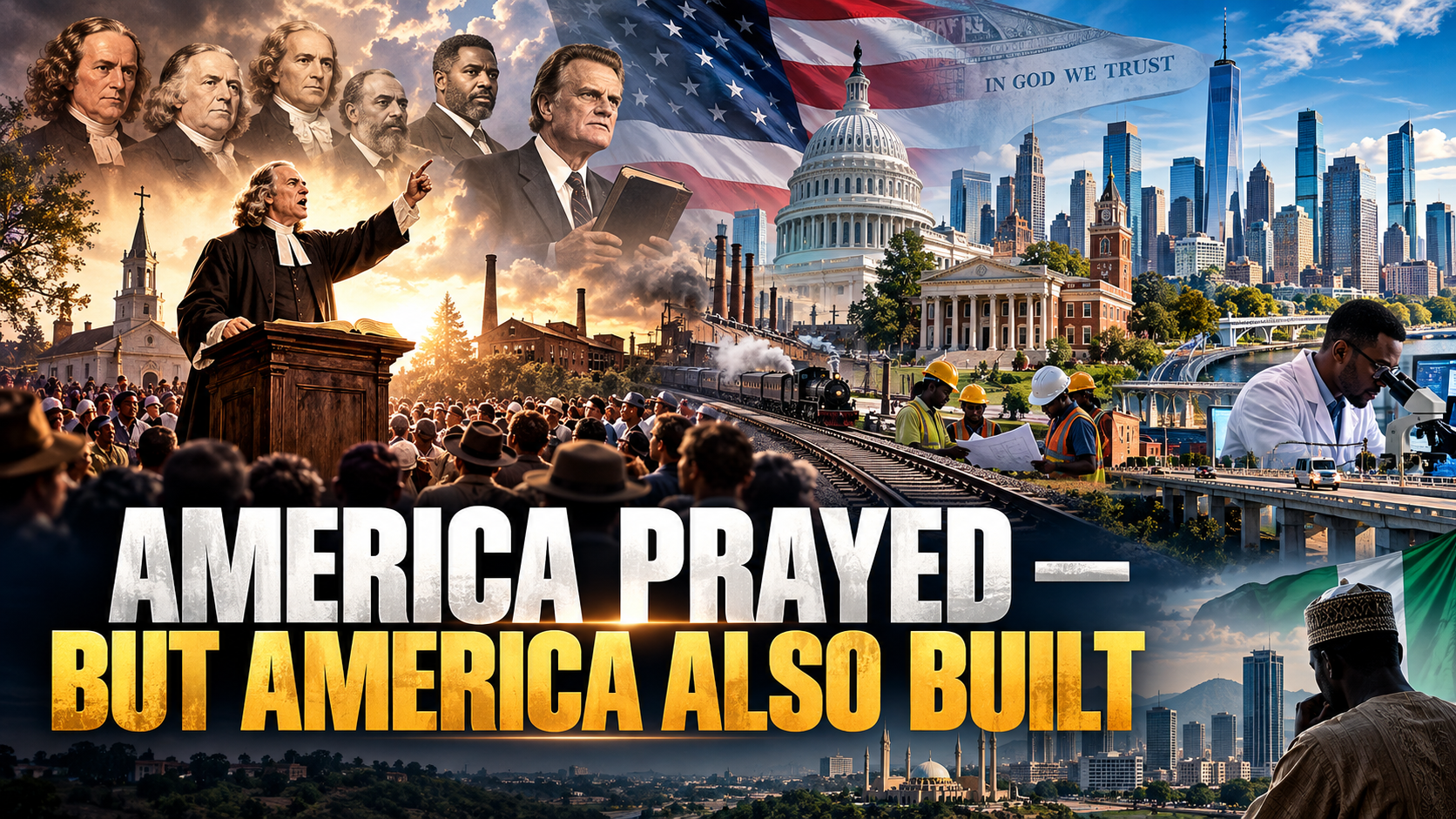
America Prayed, But America Also Built
America produced Edwards, Whitefield, Finney, Moody, Seymour and Graham, and also engineers, inventors, scientists, educators, farmers and administrators. Its development was the combined work of millions across generations. That combination matters more than slogans.
Conclusion: Revival Must Produce Nation-Builders
Spirituality and development are not enemies. Nigeria can produce evangelists and engineers, build churches and research centres, preach righteousness and construct infrastructure. The real danger is not prayer but religiosity without responsibility.
Revival cannot replace nation-building, but genuine revival should produce people who can build nations. Perhaps that is the missing part of the conversation.