Jimmy Odukoya, Fountain of Life Church Crisis: Is Ministry a Family Inheritance or a Divine Calling? What the Bible Really Says
The controversy surrounding Pastor Jimmy Odukoya and his late father’s (Pastor Taiwo Odukoya) succession instructions has reignited a fundamental question in Christianity: Should a pastor’s son automatically inherit his father’s ministry, or should God determine leadership succession?
Was Jimmy Odukoya removed as pastor of The Fountain of Life Church? This question has dominated discussions following a controversial announcement by a group of trustees claiming that Pastor Jimmy Odukoya had been removed as senior pastor. However, the church’s official leadership rejected the announcement, insisting that he remains its duly appointed senior pastor. The controversy deepened after a video attributed to the late Pastor Taiwo Odukoya surfaced, reportedly naming Pastor Kunle Areogun as his preferred successor. Beyond the leadership crisis, the development raises an important biblical question:
Should a pastor’s son automatically inherit his father’s ministry, or should divine calling determine ministerial succession?
The development has generated widespread conversations among Christians, particularly concerning the relationship between biological sonship, spiritual fatherhood, ministerial succession and divine calling.
Is ministry a family inheritance, or is it a divine assignment?
Must a pastor’s son automatically become the next general overseer simply because his father founded the church? Does biological sonship automatically confer spiritual authority? And can a man transfer his calling, anointing and ministerial assignment to his children simply because they are his biological descendants?
These questions demand more than emotional arguments, denominational loyalty, or personal opinions. They require a careful examination of the Scriptures.
The Odukoyas Controversy: What Really Happened?
The Fountain of Life Church has been at the center of a leadership dispute following announcements concerning the position of Pastor Jimmy Odukoya, who succeeded his father as senior pastor in September 2023.
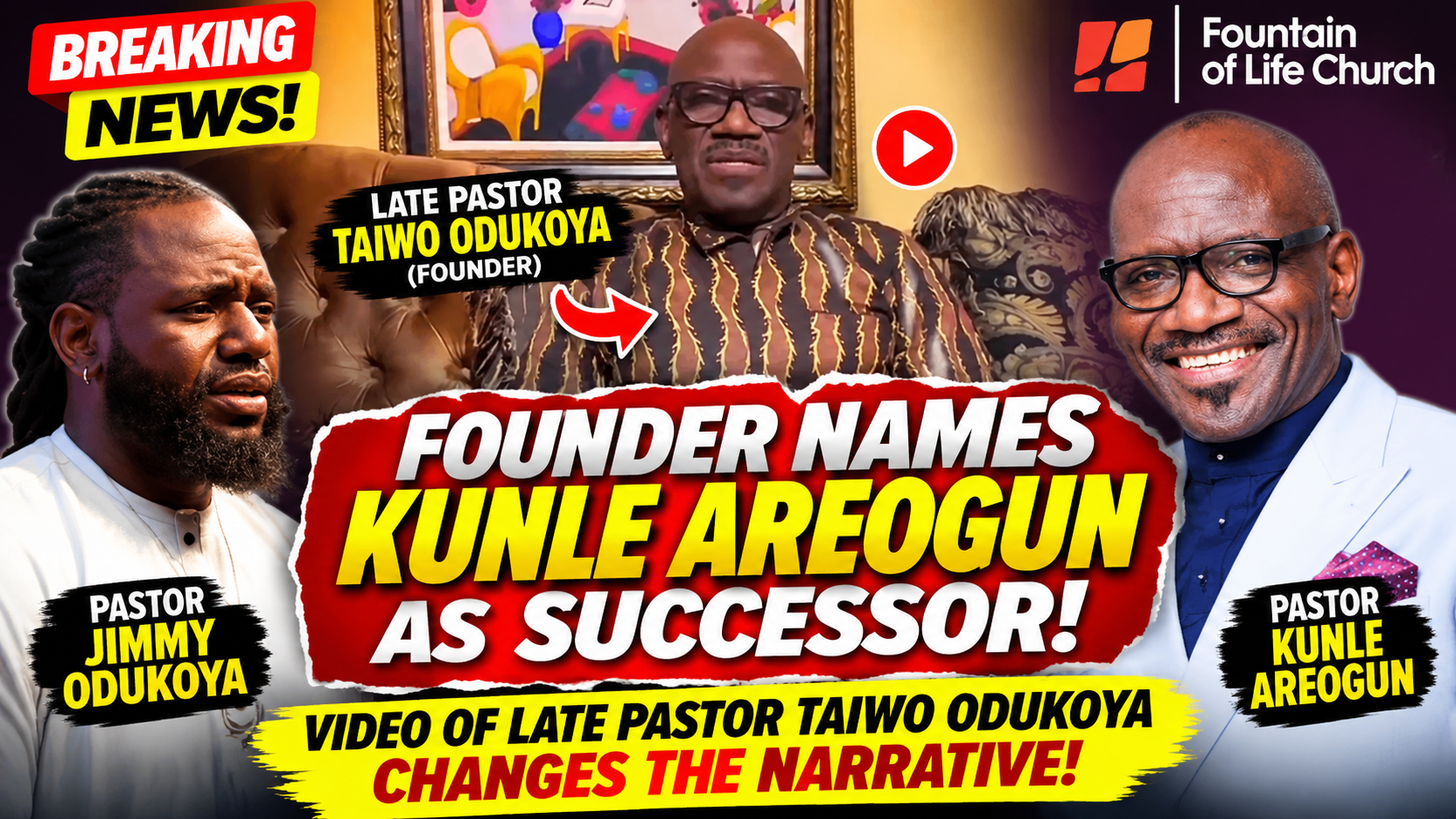
On November 17, 2026, a group of trustees released a video reportedly recorded in December 2021, in which the late Pastor Taiwo Odukoya identified Pastor Kunle Areogun as his preferred successor in the event of his death or incapacitation.
According to reports, the late founder also indicated that his son, Pastor Jimmy Odukoya, should serve in an administrative support capacity and oversee the youth church.
The trustees maintained that the recording reflected the late founder’s succession wishes. They also reaffirmed a November 16 resolution withdrawing recognition of Jimmy as Senior Pastor and announced Pastor Rotimi Okpaise as an interim leader.
However, Pastor Jimmy Odukoya and the church leadership speaking through its official communication channels rejected the announcement, insisting that his purported removal was constitutionally invalid and that he remained the duly appointed senior pastor.
Consequently, competing claims concerning the authority of the trustees, the validity of the succession process, and the church’s leadership remain unresolved.
While the leadership dispute raises important questions about church governance, it also provides an opportunity to examine a practice that has become increasingly familiar in modern Christianity: the assumption that the biological children of a church founder should automatically inherit the leadership of the ministry.
But is that assumption biblical?
1. Ministry Is a Divine Calling, Not a Biological Inheritance
The first principle that must be established is that genuine ministry originates from God.
No man becomes a legitimate minister of the Gospel simply because he was born into a minister’s family.
Hebrews 5:4 declares:
“And no man taketh this honour unto himself, but he that is called of God, as was Aaron.” — Hebrews 5:4 (KJV)
Although this passage directly concerns priestly appointment, it establishes a significant principle concerning divine authorization for sacred service.
The call of God is not a family property that can automatically be transferred from one generation to another.
A man may have five sons, but that does not mean all five have been called to preach.
One may be called into pastoral ministry, another into business, another into education, another into government, and another into an entirely different assignment.
Being the son of a pastor does not necessarily mean being the successor of that pastor.
Consider Jeremiah 1:5, where God declared that He knew Jeremiah before his birth and ordained him as a prophet to the nations.
Likewise, the Apostle Paul testified in Galatians 1:15–16 that God had separated him and called him by grace.
In both examples, divine calling originated from God’s purpose.
A father’s biological relationship with his son does not automatically establish that son’s spiritual assignment.
A son can inherit his father’s surname, wealth, property and reputation, but he cannot automatically inherit his father’s divine calling.
This distinction is essential.
2. Moses Had Biological Sons, but God Chose Joshua
Perhaps one of the clearest biblical examples of ministerial succession outside biological inheritance is the relationship between Moses and Joshua.
Moses was one of the greatest leaders in biblical history.
Through him, God delivered Israel from Egypt, performed extraordinary miracles, established the Law and guided an entire nation through the wilderness.
Interestingly, Moses had biological sons.
Exodus 18:3–4 identifies them as Gershom and Eliezer.
Yet, when the time came to appoint someone who would continue his leadership assignment, God did not automatically choose either of his sons.
Instead, God instructed Moses:
“Take thee Joshua the son of Nun, a man in whom is the spirit, and lay thine hand upon him.” — Numbers 27:18 (KJV)
This is a profound revelation about leadership succession.
Moses had sons, but Joshua was chosen to succeed him.
Joshua was not Moses’ biological child. He was a faithful servant who had walked with Moses, learned under his leadership and demonstrated commitment to God’s assignment.
In Numbers 27:18–23, Moses commissioned Joshua before Eleazar the priest and the congregation according to God’s instruction.
Deuteronomy 34:9 further records that Joshua was full of the spirit of wisdom because Moses had laid his hands upon him.
Notice the distinction.
The biological sons of Moses remained his children, but Joshua received the responsibility of leading Israel.
This demonstrates that divine assignment does not necessarily follow biological descent.
If every spiritual leader were obligated to hand over leadership to his son, Joshua would not have been the obvious successor to Moses.
The lesson for contemporary Christianity is clear: the next leader of a ministry does not have to be the founder’s biological child.
God may raise another individual who has been prepared, equipped, and appointed for that responsibility.
3. Elijah and Elisha: Spiritual Succession Without Biological Relationship
The relationship between Elijah and Elisha provides another compelling example.
Elijah was a mighty prophet through whom God performed extraordinary miracles.
Yet, when God directed him to prepare a successor, the person identified was not a biological son.
In 1 Kings 19:16, God instructed Elijah to anoint Elisha as prophet in his place.
Elisha subsequently followed Elijah and served him.
In 2 Kings 2:9, before Elijah was taken away, Elisha requested a double portion of his spirit.
Following Elijah’s departure, Elisha took up his mantle and continued in prophetic ministry.
The sons of the prophets later acknowledged that the spirit of Elijah rested upon Elisha (2 Kings 2:15).
Elisha was not Elijah’s biological son.
Nevertheless, he became his spiritual successor.
This reveals that a ministerial relationship can extend beyond family connections.
However, it is equally important to understand that spiritual sonship alone does not automatically confer divine authority.
What made Elisha’s succession significant was not merely his relationship with Elijah, but the divine direction that preceded his appointment.
A spiritual father may prepare a successor, but the legitimacy of that succession ultimately rests on God’s calling and the faithful discharge of the assignment.
4. Eli Had Sons, but Their Position Could Not Preserve Their Ministry
The story of Eli and his sons presents a serious warning.
Eli was a priest in Israel, and his sons, Hophni and Phinehas, served within the priestly institution.
Under the Old Testament arrangement, the priesthood involved a hereditary structure established by God.
However, this did not mean that biological connection exempted anyone from accountability.
First Samuel 2:12 describes Eli’s sons as corrupt men who did not know the Lord.
They dishonoured sacred responsibilities and abused their positions.
Consequently, God pronounced judgment upon Eli’s household.
In 1 Samuel 2:30, God declared:
“…for them that honour me I will honour, and they that despise me shall be lightly esteemed.” — 1 Samuel 2:30 (KJV)
Meanwhile, God was raising Samuel, a young man who was not Eli’s biological son.
Samuel eventually emerged as a prophet and spiritual leader in Israel.
Although Samuel did not simply replace every hereditary priestly function of Eli’s family, his emergence demonstrates that God can raise faithful leadership beyond an existing ministerial household.
A man may occupy a religious office because of his family background and still fail to fulfil the responsibilities of that office.
Family connection cannot substitute for godly character, obedience and spiritual maturity.
This should be a serious warning to churches that treat leadership succession primarily as a matter of family entitlement.
5. Abraham, Isaac, Jacob and the Twelve Tribes: Did Everyone Inherit the Same Assignment?
Another important argument concerns the patriarchs of Israel.
Abraham received divine promises, and those promises continued through Isaac and Jacob.
Some may use this pattern to suggest that spiritual assignments must always pass from father to son.
But a careful examination of Scripture reveals a more complex picture.
Abraham had Ishmael, yet God specifically established His covenant through Isaac (Genesis 17:18–21).
Isaac had Esau and Jacob, but the covenantal promise continued through Jacob (Genesis 25:23; Romans 9:10–13).
Even within the patriarchal family, divine purpose was not determined simply by seniority or paternal preference.
Furthermore, Jacob had twelve sons who became the ancestors of the twelve tribes of Israel.
Yet those tribes did not all occupy identical spiritual responsibilities.
The tribe of Levi was set apart for priestly service, while Judah became associated with the royal line.
The nation later experienced division into the kingdoms of Israel and Judah following Solomon’s reign.
These events demonstrate the diversity of assignments within the covenant community.
However, we must not confuse the inheritance of God’s covenant promises with the transfer of a particular ministerial office.
The patriarchal covenant and the New Testament pastoral ministry are not identical institutions.
Therefore, the fact that God’s covenant continued through Abraham’s descendants does not establish a universal biblical requirement that every pastor must hand over his church to his biological children.
Being born into a family associated with God’s work does not automatically make every member of that family the appointed leader of that work.
6. Can a Pastor’s Son Legitimately Take Over His Father’s Ministry?
Absolutely.
This is where balance is necessary.
The argument is not that the biological son of a pastor should never succeed his father.
That would be an equally incorrect conclusion.
There is nothing inherently unbiblical about a pastor’s son becoming the next senior pastor or general overseer.
The central question is whether that son is genuinely called, spiritually qualified, adequately prepared and properly appointed.
A son may have spent years serving alongside his father, learning the vision of the ministry, developing spiritual maturity and demonstrating considerable leadership ability.
If such a person meets the biblical qualifications for leadership, there is no scriptural reason to disqualify him simply because his father founded the church.
However, his biological relationship should not be treated as sufficient evidence of qualification.
The Apostle Paul outlined important requirements for spiritual leadership in 1 Timothy 3:1–7 and Titus 1:5–9.
These include godly character, self-control, faithfulness, maturity, sound doctrine, and the ability to teach.
Interestingly, being the biological son of a founder is not listed as a requirement.
In 2 Timothy 2:2, Paul instructed Timothy to commit what he had learned to faithful people who would be able to teach others.
He did not instruct Timothy to reserve the assignment for his biological children.
The emphasis was on faithfulness and competence.
Therefore, the biblical position must remain balanced.
A son should not be denied leadership merely because he is the founder’s child.
But neither should he receive leadership merely because he is the founder’s child.
A pastor’s son may succeed his father, but he must not succeed merely on the strength of his father’s name.
7. Can a Father Transfer His Anointing and Calling to His Son?
This question goes to the heart of the discussion.
In many contemporary Christian circles, we frequently hear expressions such as the transfer of mantles, generational anointing, and the inheritance of spiritual grace.
But what does the Bible actually teach?
Scripture recognizes the laying on of hands, spiritual commissioning, mentorship, and the recognition of divine gifts.
For example, Paul instructed Timothy in 2 Timothy 1:6 to stir up the gift of God associated with the laying on of Paul’s hands.
Similarly, 1 Timothy 4:14 speaks about a spiritual gift associated with prophecy and the laying on of hands by the elders.
These passages demonstrate that spiritual gifts may be recognized and encouraged through established ministerial practices.
Nevertheless, the ultimate source of spiritual gifts remains God.
First Corinthians 12:11 teaches that the Holy Spirit distributes gifts according to His will.
A father can mentor his son.
A father can train his son.
A father can pray for his son.
A father can recommend his son for leadership.
A father can even participate in commissioning him for ministry.
But a father cannot independently manufacture God’s calling upon his son’s life.
That authority belongs to God.
It would therefore be a serious theological mistake to assume that a spiritual gift, pastoral calling or apostolic assignment automatically passes through biological descent.
The anointing of God is not a family estate, and the calling of God is not an item in a father’s will.
8. The Danger of Turning Ministry Into a Family Dynasty
One of the troubling tendencies in modern Christianity is the gradual transformation of some churches into institutions where leadership is assumed to belong permanently to the founder’s family.
A man receives a vision, establishes a church, labours for decades and builds a congregation.
Over time, the ministry grows in influence, membership, property and financial resources.
Then, when succession becomes necessary, the discussion may shift from discerning God’s direction to preserving the family’s control of the institution.
In some cases, the founder’s children become the presumed successors regardless of whether they have demonstrated the necessary qualifications.
This is dangerous.
Not because family involvement in ministry is wrong, but because the Church must never become a private dynasty.
Jesus declared in Matthew 16:18:
“…I will build my church; and the gates of hell shall not prevail against it.” — Matthew 16:18 (KJV)
Notice His words.
He called it My church.
The Church belongs to Christ.
A founder may establish a congregation through obedience to God’s calling, but that does not make the people of God his personal possessions.
The Apostle Paul understood this distinction.
In 1 Corinthians 3:6, he declared:
“I have planted, Apollos watered; but God gave the increase.” — 1 Corinthians 3:6 (KJV)
Paul planted.
Apollos watered.
God gave the increase.
Different individuals performed different assignments within the same divine work.
Neither Paul nor Apollos could legitimately claim ownership of the Church.
Likewise, one minister may establish a ministry while another is called to continue, strengthen or expand it.
The successor does not necessarily have to share the founder’s surname.
The Church is not a family business, and the pulpit should never become a hereditary throne.
9. The Success of a Ministry Should Not Depend Solely on the Founder’s Children
Another important issue is what happens to a ministry after its founder dies.
Throughout Christian history, some ministries have remained influential for generations, while others have struggled following the death of their founding leaders.
The reasons vary.
Poor succession planning, unresolved internal disputes, weak institutional structures, inadequate leadership preparation and changes in vision may all contribute to difficulties.
It would be unfair to claim that every ministry led by a founder’s child eventually declines.
There are family-led ministries that have remained stable and influential.
Likewise, ministries led by successors outside the founder’s family can experience serious challenges.
The real issue is not the biological identity of the successor, but the quality, legitimacy and faithfulness of the succession.
Consider the late Dr. Myles Munroe.
Years after his death in 2014, his teachings on purpose, leadership and personal development continue to reach audiences across the world.
His enduring influence demonstrates that a minister’s legacy is not limited to the person occupying his former office.
A genuine spiritual legacy should produce disciples, develop leaders, preserve sound teaching and strengthen institutions capable of continuing the work.
The greatest achievement of a minister is not necessarily producing a biological heir who occupies his pulpit.
It is fulfilling the assignment entrusted to him and raising people who will faithfully serve God’s purposes beyond his lifetime.
A successful ministry is not merely one that survives the founder’s death, but one that remains faithful to its divine purpose after the founder is gone.
10. What the Jimmy Odukoya Controversy Should Teach Christian Leaders
Returning to Pastor Jimmy Odukoya and the ongoing leadership dispute at The Fountain of Life Church, it is essential to separate personal opinions from verifiable facts.
The existence of a video expressing Pastor Taiwo Odukoya’s preferred succession arrangement raises questions about the founder’s wishes and how those wishes relate to the church’s subsequent leadership decisions.
However, the recording alone does not establish whether Jimmy possesses a genuine pastoral calling.
Neither does his biological relationship with the founder prove that he is automatically entitled to the position.
Conversely, being the founder’s son does not disqualify him from leadership.
These are separate matters.
The church’s governing constitution, the legitimacy of the trustees’ decisions, the circumstances of the 2023 appointment and the competing interpretations of succession authority require careful examination.
A founder’s expressed wishes may be important to that process, but their institutional effect cannot be determined without considering the church’s lawful governance arrangements.
Likewise, questions about spiritual calling cannot be conclusively settled through social media speculation.
It would therefore be irresponsible to declare Pastor Jimmy spiritually unqualified merely because his late father reportedly preferred another successor.
It would be equally irresponsible to dismiss the founder’s reported instructions without examining their relevance to the church’s legitimate governance process.
The Church must be guided by truth, fairness and order.
First Corinthians 14:40 declares:
“Let all things be done decently and in order.” — 1 Corinthians 14:40 (KJV)
The public disagreement should remind Christian organizations of the importance of clear succession planning, transparent governance, responsible leadership structures and peaceful conflict resolution.
Church members should not become casualties of unresolved leadership struggles.
The reputation of Christ’s Church must remain greater than the personal ambitions or institutional interests of any individual or group.
11. What Should Determine Ministerial Succession?
If biological relationship alone is insufficient, what should guide the appointment of a spiritual successor?
The New Testament provides several important principles.
First, there must be credible evidence of divine calling.
Second, the individual must demonstrate the biblical qualifications for spiritual leadership, including godly character, sound doctrine and spiritual maturity.
Third, there should be evidence of preparation, competence, faithfulness and commitment to the work.
Fourth, the succession process should respect legitimate church governance and accountability.
Finally, the welfare of the congregation and the advancement of Christ’s mission must remain central.
In Acts 13:2–3, Barnabas and Saul were set apart for missionary work in an atmosphere of worship, fasting and prayer.
In Acts 6:1–6, the early church responded to an administrative challenge by identifying qualified individuals and commissioning them for service.
These examples demonstrate the importance of spiritual discernment, qualifications and orderly appointment.
They do not establish a single institutional succession formula for every modern church, but they provide principles that Christian leaders should take seriously.
God’s work must never be reduced to popularity, family entitlement, financial influence or personal preference.
The calling, competence and character of a potential successor must matter.
Conclusion: The Pulpit Is Not a Family Inheritance
The controversy involving Pastor Jimmy Odukoya, Pastor Kunle Areogun and the leadership of The Fountain of Life Church has brought a difficult but necessary conversation to the forefront of Nigerian Christianity.
And perhaps this is an opportunity for churches to reconsider how ministerial succession is understood and practised.
The biblical evidence does not support the assumption that every pastor must automatically transfer the leadership of his ministry to his biological son.
Moses had sons, but God chose Joshua.
Elijah was succeeded by Elisha, who was not his biological child.
Eli’s sons occupied priestly positions, but their family connection could not protect them from divine judgment.
Paul entrusted Timothy with important spiritual responsibilities and instructed him to raise faithful people capable of teaching others.
These examples point toward a consistent principle: the continuation of God’s work must not be confused with biological entitlement.
This does not mean that God cannot call a minister’s son to continue his father’s assignment.
He certainly can.
But the fact that someone is a son does not automatically mean he is a successor.
A father may leave properties, financial resources, institutional assets and a respected name to his children.
He may also mentor them, recommend them and prepare them for leadership.
But he cannot simply bequeath a divine calling as though it were a piece of family property.
A man can inherit his father’s church building without inheriting his father’s calling. He can inherit his father’s surname without inheriting his father’s assignment. And he can inherit his father’s reputation without automatically inheriting his father’s spiritual authority.
The calling belongs to God.
The Church belongs to Christ.
And every minister, regardless of family background, must remain a faithful steward of the responsibility entrusted to him.
As the Fountain of Life Church navigates its current dispute, Christians should pray for wisdom, reconciliation, justice, and an outcome that protects the congregation and honours Christ.
Rather than hastily condemning individuals, believers should allow the controversy to provoke a deeper examination of Scripture and church leadership.
Because ultimately, the most important question is not whether a man is the biological son of a great pastor.
It is whether he is genuinely called, biblically qualified, and faithfully appointed to the responsibility he has been given.
Ministry is not an inheritance to be claimed by blood. It is a sacred responsibility to be fulfilled according to God’s purpose.
And when the assignment of one generation is complete, the continuation of God’s work must never be reduced to the preservation of a family dynasty.
The founder may have a son, but God may have chosen another successor. And if God has indeed chosen the son, his calling and qualifications must matter more than his surname.
What do you think? Should the biological son of a church founder automatically succeed his father, or should the church prioritize divine calling, biblical qualifications and spiritual maturity regardless of family relationship? Share your thoughts.