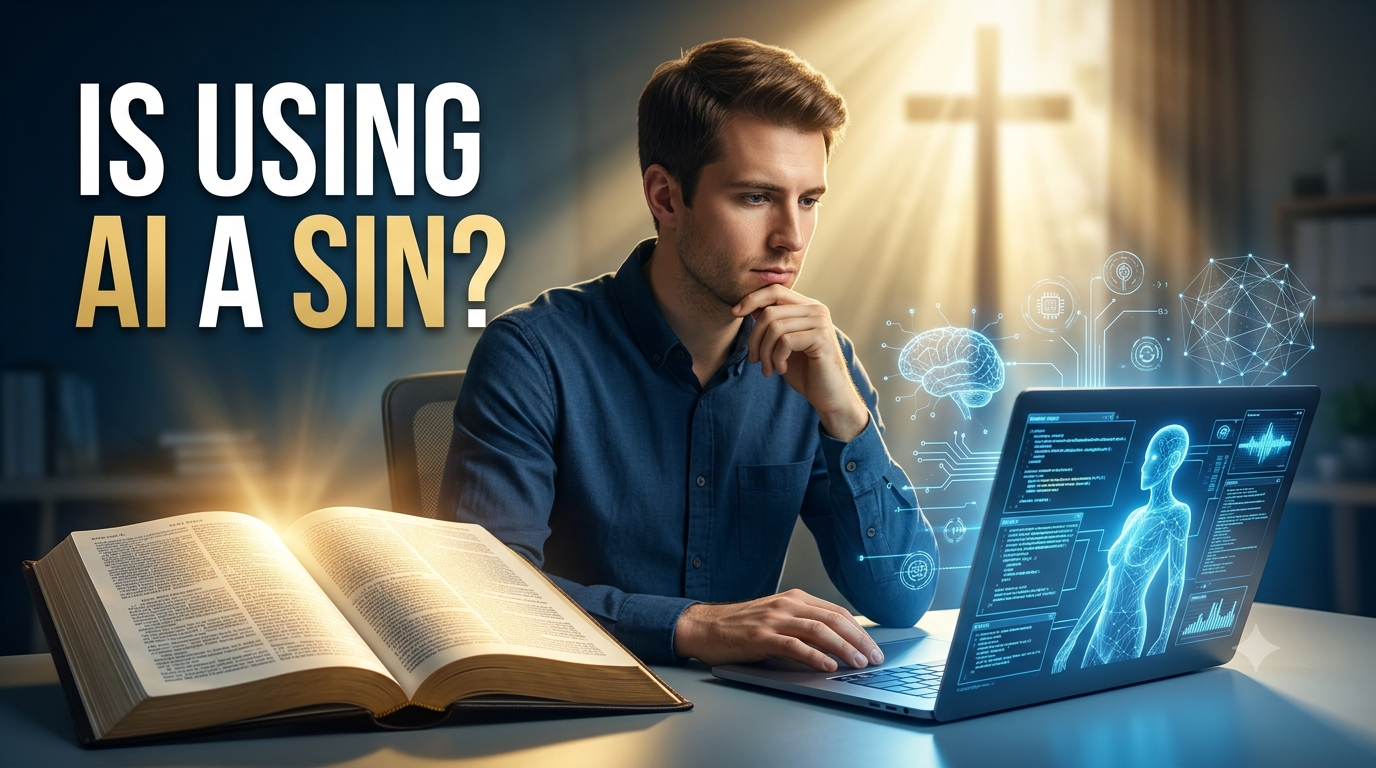
Is Using Artificial Intelligence a Sin? What Christians Should Know About AI
Artificial intelligence has rapidly become part of everyday life. People now use AI tools to write emails, research topics, create images, translate languages, analyse information, prepare business proposals, and even study the Bible.
As these technologies become more powerful, many believers are asking important questions:
ALSO, READ Healing from a Harmful Church | Recover from Church Hurt Biblically (EBOOK)
Is using artificial intelligence a sin? Can Christians use ChatGPT? Is AI spiritually dangerous? Does the Bible warn us about artificial intelligence? Can pastors use AI to prepare sermons?
The simple answer is that using artificial intelligence is not automatically a sin. AI is a human-made tool, and like many other technologies, its moral value depends largely on how it is designed, how it is used, and what purpose it serves.
A knife can prepare food or harm someone. Money can support ministry or finance corruption. The internet can spread the gospel or promote immorality. In the same way, artificial intelligence can be used for education, productivity, and evangelism—or for deception, exploitation, and sin.
The more important question is therefore not merely, “Is AI sinful?” but:
Am I using artificial intelligence in a way that honours God, respects people, promotes truth and preserves my spiritual responsibility?
What Is Artificial Intelligence?
Artificial intelligence refers to computer systems designed to perform tasks commonly associated with human intelligence. These tasks may include analysing information, recognizing patterns, generating language, creating images, making predictions, translating text, and solving problems.
GET THE FULL EBOOK ON THIS TOPIC
However, AI is not a human being.
It does not possess a human spirit, a God-given soul, moral accountability or a personal relationship with God. It processes information according to data, programming, statistical patterns and instructions.
This distinction is important because Scripture gives humanity a unique identity:
“So God created man in his own image, in the image of God created he him; male and female created he them.”
— Genesis 1:27
Human value does not come merely from intelligence, productivity or the ability to process information. Humanity has dignity because men and women were created in the image of God.
Christian discussions about AI have therefore increasingly emphasized that technology should serve human beings rather than replace human dignity, moral responsibility or genuine relationships. The Lausanne Movement has similarly argued that Christian ethics must preserve humanity’s identity as image-bearers of God and prevent technology from interfering with communion with God and relationships with others.
Is Artificial Intelligence Mentioned in the Bible?
The Bible does not directly mention artificial intelligence, computers, machine learning, smartphones or ChatGPT.
These technologies did not exist when the Scriptures were written.
However, the Bible gives timeless principles that can guide Christians in deciding how to use new technologies.
Scripture teaches believers to examine their actions, motives and influences carefully:
“Prove all things; hold fast that which is good.”
— 1 Thessalonians 5:21
The Bible also says:
“Whether therefore ye eat, or drink, or whatsoever ye do, do all to the glory of God.”
— 1 Corinthians 10:31
Therefore, Christians should not merely ask whether the Bible names a particular technology. We should ask whether our use of that technology agrees with biblical principles.
Is Using AI Automatically a Sin?
No. Using AI is not automatically sinful.
Artificial intelligence is a tool. A Christian may use it for legitimate and beneficial purposes, such as:
- Learning new skills
- Improving grammar and communication
- Translating Christian materials
- Organizing information
- Developing business ideas
- Analysing non-confidential data
- Creating lesson outlines
- Generating administrative documents
- Brainstorming content
- Making information more accessible
- Supporting people with disabilities
- Preparing questions for further research
These activities are not inherently sinful.
The Bible contains many examples of people using the available tools, knowledge, and skills of their generation for productive purposes.
Bezalel was filled with wisdom and skill to produce artistic work for the tabernacle:
“And I have filled him with the spirit of God, in wisdom, and in understanding, and in knowledge, and in all manner of workmanship.”
— Exodus 31:3
The Apostle Paul used roads, letters, ships, and the common language of his world to spread the gospel. Technology itself was not the message, but it helped the message travel.
Similarly, artificial intelligence may become useful when it remains a servant rather than becoming a substitute for truth, wisdom, human responsibility, or dependence on God.
When Can Using Artificial Intelligence Become Sinful?
Although AI is not automatically sinful, a person can use it in sinful ways.
1. When AI Is Used to Deceive People
A Christian should not use artificial intelligence to impersonate someone, fabricate evidence, create deceptive testimonials or pretend to have produced work that they did not honestly create.
The Bible says:
“Wherefore putting away lying, speak every man truth with his neighbour.”
— Ephesians 4:25
Using AI to create fake news, false prophecies, manipulated videos, fraudulent documents or dishonest academic work violates the biblical command to speak truth.
AI-generated images and videos can sometimes appear realistic. This makes honesty even more important. Christians should not deliberately deceive people into believing that an artificial recording or image is genuine.
2. When AI Is Used for Cheating or Plagiarism
Using AI to support learning is different from asking it to complete an examination, assignment or professional task that you are required to perform personally.
A student who submits entirely AI-generated work while claiming it as independent work may be acting dishonestly.
A preacher who copies an AI-generated sermon, presents it as a revelation personally received from God and refuses to verify its content may also misrepresent the source of the material.
Scripture says:
“Providing for honest things, not only in the sight of the Lord, but also in the sight of men.”
— 2 Corinthians 8:21
Christians should follow the rules governing their schools, workplaces, competitions and professional responsibilities.
3. When AI Is Used to Produce Immoral Content
Using artificial intelligence to create pornography, promote violence, facilitate fraud, spread hatred or exploit vulnerable people is sinful.
The problem in such cases is not merely the technology. The problem is the intention and action of the person using it.
Jesus taught that sin can begin in the heart:
“For from within, out of the heart of men, proceed evil thoughts, adulteries, fornications, murders.”
— Mark 7:21
AI should never become a faster way of carrying out desires that already contradict the Word of God.
4. When AI Replaces Dependence on God
Artificial intelligence can provide information, but it cannot replace prayer, spiritual discernment, biblical meditation or the leading of the Holy Spirit.
A Christian should not treat an AI system as an all-knowing spiritual authority.
The Bible says:
“Trust in the Lord with all thine heart; and lean not unto thine own understanding.”
— Proverbs 3:5
AI can analyse religious texts, but it cannot know God personally. It can generate a prayer, but it cannot pray with faith. It can describe repentance, but it cannot repent. It can summarize Scripture, but it cannot receive revelation from the Holy Spirit.
Technology becomes spiritually dangerous when believers begin consulting it more faithfully than they consult God.
5. When AI Becomes an Idol
Anything can become an idol when it receives the trust, devotion, attention or dependence that belongs to God.
Some people may begin to believe that AI will solve every human problem, eliminate the need for moral accountability or create a perfect society.
Christians must reject every form of technological idolatry.
“Thou shalt have no other gods before me.”
— Exodus 20:3
Artificial intelligence may be powerful, but it is not divine. It is not omniscient, omnipotent or morally perfect.
It should never be feared as though it were greater than God, and it should never be worshipped as though it were humanity’s saviour.
6. When AI Is Used Without Concern for Privacy
Christians should be careful about entering private information into AI systems.
This may include:
- Church counselling records
- Medical information
- Personal confessions
- Members’ financial information
- Private family disputes
- Unpublished business strategies
- Children’s personal data
- Confidential workplace documents
Christian analysis of AI use in churches has raised concerns about applications collecting and analysing large amounts of congregants’ data, sometimes without users fully understanding how that information is processed.
Love for one’s neighbour includes protecting people from unnecessary exposure and harm.
“A talebearer revealeth secrets: but he that is of a faithful spirit concealeth the matter.”
— Proverbs 11:13
7. When AI Encourages Laziness
AI can increase productivity, but it can also weaken discipline when people use it to avoid learning, thinking, studying, or developing their gifts.
The Bible says:
“The soul of the sluggard desireth, and hath nothing: but the soul of the diligent shall be made fat.”
— Proverbs 13:4
A writer who never learns to write, a student who never studies, and a preacher who never searches the Scriptures may gradually become dependent on artificial assistance.
Technology should strengthen faithful work—not eliminate responsibility.
Can Christians Use ChatGPT?
Yes, Christians can use ChatGPT and similar AI tools, provided they use them honestly, responsibly, and with discernment.
ChatGPT may help a Christian:
- Generate Bible-study questions
- Compare different explanations of a subject
- Improve the clarity of written content
- Create a reading schedule
- Summarize notes
- Organize research
- Translate ministry material
- Brainstorm sermon illustrations
- Develop youth programme ideas
- Prepare administrative documents
However, its answers must be verified.
AI language models can generate information that sounds convincing but is incorrect. OpenAI acknowledges that language models can sometimes produce plausible but false statements, a problem commonly described as “hallucination”.
Therefore, Christians should not assume that an answer is correct simply because it sounds intelligent.
Check:
- Every Bible quotation
- Every chapter and verse
- Every historical claim
- Every quotation attributed to a preacher
- Every theological definition
- Every medical or legal statement
- Every statistic
- Every source or book reference
The Word of God remains the authority—not the AI tool.
Can Pastors Use AI to Prepare Sermons?
A pastor may use AI as a research or administrative assistant, but artificial intelligence MUST NEVER replace personal study, prayer, theological training, or dependence on the Holy Spirit.
Paul instructed Timothy:
“Study to shew thyself approved unto God, a workman that needeth not to be ashamed, rightly dividing the word of truth.”
— 2 Timothy 2:15
The command is directed to the minister. The pastor remains responsible for studying and rightly interpreting Scripture.
AI may help organise an outline, suggest questions or improve grammar. But the minister must personally:
- Pray
- Study the biblical text
- Understand its context
- Verify interpretations
- Discern the needs of the congregation
- Ensure doctrinal accuracy
- Speak truth with conviction
- Remain accountable before God
A sermon should not merely be an impressive arrangement of words. Biblical preaching involves truth, character, spiritual responsibility, and pastoral love.
A machine cannot know the congregation, carry a burden for souls, or stand before God in accountability for how Scripture was handled.
Can AI Replace the Holy Spirit?
No. Artificial intelligence cannot replace the Holy Spirit.
Jesus described the Holy Spirit as the Comforter, Teacher and Spirit of truth:
“But the Comforter, which is the Holy Ghost, whom the Father will send in my name, he shall teach you all things.”
— John 14:26
The Holy Spirit convicts people of sin, reveals Christ, empowers believers, produces spiritual fruit, distributes spiritual gifts, and guides the church.
AI does none of these things.
It may imitate religious language, but imitation is not anointing.
It may generate emotional prayers, but generated language is not spiritual communion.
It may produce sermon outlines, but an outline is not divine authority.
Christians should never say, “The AI told me what God is saying,” as though a computer system were a prophet or divine messenger.
God may use many ordinary tools to help us learn, but all claims of spiritual guidance must be tested by Scripture.
Does AI Have a Soul?
There is no biblical reason to believe that artificial intelligence possesses a human soul.
AI may use words such as “I think”, “I understand”, or “I feel”, but these expressions do not prove that it experiences life as a human being does.
A system may simulate conversation without possessing human consciousness, moral responsibility or spiritual life.
Human beings are not simply biological computers. According to Scripture, humanity was uniquely created in God’s image.
“And the Lord God formed man of the dust of the ground, and breathed into his nostrils the breath of life.”
— Genesis 2:7
Christians should therefore avoid confusing impressive imitation with actual personhood.
Is Artificial Intelligence the Antichrist?
The Bible does not identify artificial intelligence as the Antichrist.
Some Christians connect AI with end-time prophecies because of concerns about surveillance, economic control, deception, and powerful global systems.
These concerns deserve thoughtful discussion. Technology can certainly be used by governments, corporations or individuals for oppression, manipulation and control.
However, Christians should avoid making claims that Scripture itself does not clearly make.
Jesus warned believers against deception:
“Take heed that no man deceive you.”
— Matthew 24:4
That warning should produce vigilance—not speculation presented as certainty.
AI may become part of future political, economic or religious systems, but the Bible does not explicitly say, “Artificial intelligence is the Antichrist.”
Christians must distinguish between biblical teaching and personal interpretation.
What Does Christian Wisdom Say About AI?
Christian wisdom rejects two extremes.
The first extreme says:
“All artificial intelligence is demonic and every Christian must reject it.”
The second extreme says:
“AI is unquestionably good, and Christians should adopt everything it offers.”
Neither position demonstrates sufficient discernment.
A wise Christian recognises both opportunities and dangers.
A major 2025 Vatican document on artificial and human intelligence described AI as presenting both challenges and opportunities while emphasising that its development and use must uphold human dignity and promote the good of individuals and society.
The Lausanne Movement has similarly described AI as potentially useful to Christian mission while warning believers against blindly embracing it or allowing it to replace essential human and spiritual relationships.
Christians should therefore remain the following:
- Biblically grounded
- Spiritually discerning
- Intellectually honest
- Morally responsible
- Careful with personal data
- Compassionate toward people affected by automation
- Alert to deception
- Open to legitimate innovation
- Unwilling to compromise truth
Seven Questions Christians Should Ask Before Using AI
Before using an artificial-intelligence tool, ask yourself:
1. Does This Use Glorify God?
“Do all to the glory of God.”
— 1 Corinthians 10:31
Can you sincerely ask God to bless what you are doing?
2. Am I Being Honest?
Are you deceiving your teacher, employer, audience, client or congregation about how the work was created?
3. Could This Harm Someone?
Could the content damage a person’s reputation, privacy, livelihood, or spiritual wellbeing?
4. Have I Verified the Information?
Do not publish false claims simply because an AI system generated them confidently.
5. Am I Violating Someone’s Privacy?
Never upload confidential information merely for convenience.
6. Is AI Supporting or Replacing My Responsibility?
Use AI to assist faithful work, not to avoid the work God has entrusted to you.
7. Is This Drawing Me Closer to or Away From God?
A tool becomes spiritually unhealthy when it replaces prayer, Scripture, fellowship, wisdom, and obedience.
Practical Guidelines for Christians Using AI
Christians who choose to use artificial intelligence should observe the following boundaries:
- Verify every important claim.
Never assume generated information is automatically correct. - Do not share confidential information.
Protect private church, family, medical and business data. - Disclose AI involvement when necessary.
Follow workplace, academic, and publishing policies. - Do not use AI to impersonate people.
Avoid deceptive voice clones, fake testimonies, and manipulated videos. - Respect copyright and ownership.
Do not use AI to steal or reproduce someone else’s protected work. - Keep humans accountable.
A pastor, doctor, teacher, lawyer, or leader must remain responsible for decisions. - Do not treat AI as a spiritual authority.
Test every religious claim by Scripture. - Protect your mind.
Refuse immoral, hateful, or addictive uses of technology. - Continue developing your gifts.
Do not let automation make you intellectually or spiritually lazy. - Pray for wisdom.
God’s wisdom is greater than technological knowledge.
“If any of you lack wisdom, let him ask of God.”
— James 1:5
Frequently Asked Questions
Is artificial intelligence evil?
Artificial intelligence is not inherently evil. It is a human-developed technology that can be used for good or evil purposes. The morality of its use depends on the intention, method, and consequences involved.
Is using ChatGPT against Christianity?
No. Using ChatGPT is not automatically against Christianity. It becomes problematic when it is used for deception, immorality, plagiarism, manipulation or as a replacement for Scripture and the Holy Spirit.
Can Christians use AI to write prayers?
AI may help someone organize prayer points, but genuine prayer must come from a person sincerely communicating with God. Reading an AI-generated prayer is not necessarily wrong, but believers should not allow generated language to replace a personal prayer life.
Can AI understand the Bible?
AI can analyse biblical language, commentaries, and patterns in religious texts. However, it does not possess saving faith, spiritual discernment, or a relationship with God. Its explanations must be verified carefully.
Can AI preach the gospel?
AI can reproduce or distribute gospel content, but it cannot personally believe, repent, testify, or obey Christ. Evangelism is ultimately the responsibility of Christ’s followers.
Is AI a sign of the end times?
AI may contribute to systems that resemble concerns found in end-time discussions, including surveillance and deception. However, the Bible does not specifically identify artificial intelligence as a fulfilment of one particular prophecy.
Should churches use artificial intelligence?
Churches may use AI for administration, translation, communication, accessibility and research. They should establish clear policies concerning privacy, accuracy, disclosure, pastoral care, and doctrinal accountability.
Can a Christian use AI-generated images?
Yes, provided the images are not deceptive, immoral, defamatory, exploitative, or used to violate ownership rights. AI-generated illustrations should be identified when their artificial nature could mislead viewers.
Can AI give spiritual advice?
AI can summarize biblical or counselling material, but it should not replace pastors, mature Christian counsel, professional care or the leading of the Holy Spirit. Serious spiritual, medical, or mental-health issues require responsible human support.
Will AI replace pastors?
AI may automate some administrative and content-related tasks, but it cannot replace the biblical calling, character, accountability, compassion, and spiritual responsibility of a genuine pastor.
Conclusion: Is Using Artificial Intelligence a Sin?
Using artificial intelligence is not automatically a sin.
AI is a tool, and Christians may use it for learning, communication, business, creativity, research, administration, and even certain forms of ministry support.
However, using AI becomes sinful when it involves:
- Lying
- Cheating
- Plagiarism
- Exploitation
- Immorality
- Theft
- Manipulation
- Privacy violations
- Idolatry
- Spiritual deception
- Deliberate harm
The Christian response to artificial intelligence should therefore be neither panic nor blind acceptance.
Believers are called to test everything, retain what is good, and reject what is evil.
“And be not conformed to this world: but be ye transformed by the renewing of your mind.”
— Romans 12:2
Let AI remain a tool in your hand—not a master over your mind.
Let it support your work—not replace your responsibility.
Let it help you organize information—but never allow it to replace the Word of God, the wisdom of God, or the Spirit of God.
Technology will continue to change, but Jesus Christ remains the same.
“Jesus Christ the same yesterday, and to day, and for ever.”
— Hebrews 13:8
A Prayer for Wisdom in the Age of Artificial Intelligence
Heavenly Father, thank You for the wisdom, creativity, and abilities You have given humanity. As technology continues to develop, grant me discernment to recognise what is good and courage to reject what is evil.
Help me to use every tool in a way that honours You, protects others, and promotes truth. Keep me from deception, laziness, pride, and unhealthy dependence on technology.
May no invention take Your place in my heart. Teach me to depend on Your Word, listen to the Holy Spirit, and walk in wisdom.
Let my knowledge increase without my love growing cold. Let technology serve Your purposes in my life without becoming my master.
Give wisdom to Christian leaders, parents, teachers, creators, and young people as they navigate this changing world.
In Jesus’ name, Amen.